SYSTEMFIT
Make it easier for users to begin, continue, and return
I review product flows and deliver concrete corrections to the demands, timing, and feedback that can interrupt participation.
How I work
The review focuses on one defined journey in your product—for example, onboarding, returning after inactivity, or changing an existing plan.You receive:
• 3–5 prioritized corrections• Annotated screens showing the relevant interaction points• Clear reasoning connecting each issue to its proposed correction• Suggested interface wording or flow changes• A focused plan for testing the changesWe agree on the flow and scope before work begins.
Full breakdown
How Duolingo’s return flow can make restarting harder
Independent product analysis
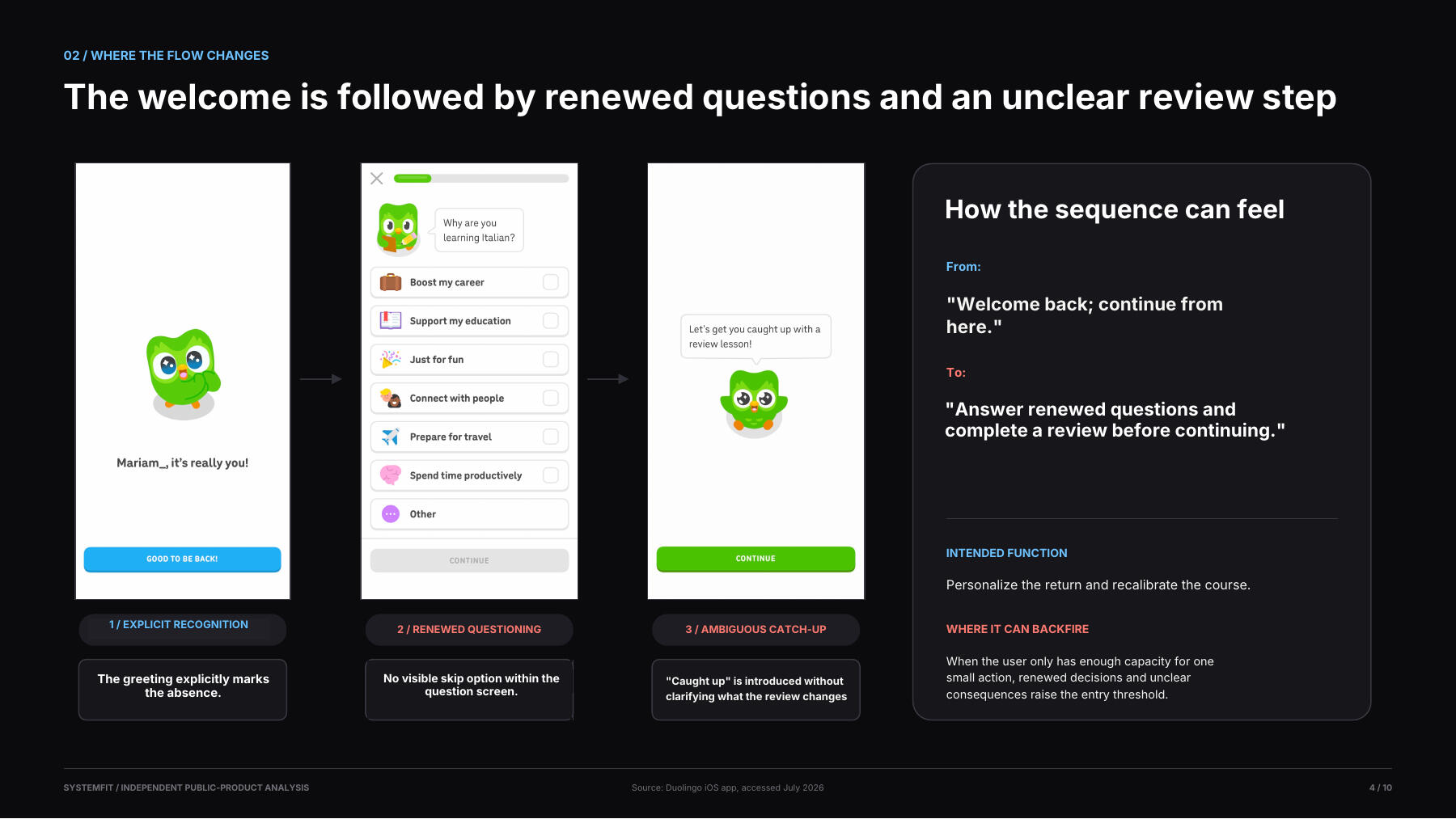
A detailed look at how Duolingo’s return flow combines immediate effort with future commitment—and how to make restarting easier while preserving the product’s retention goals.Includes observed screens, the reasoning behind the diagnosis, a revised flow, and concrete interface corrections.View the full analysis (PDF, 10 pages)
Other interaction patterns I review
Four situations where a product’s requirements, controls, or prompts can make the next step harder.
Returning to a product
A user comes back to resume one activity. Before they can continue, the product asks them to repeat setup, catch up, or commit to a routine.Someone ready for that activity may not be ready for everything attached to it.What I’d change
Provide a direct path to the next activity. Keep refreshers and routine-setting available as optional support.
Entering information
A journal or support form requires a written explanation before the user can proceed. Someone may know what they want to record or request but struggle to formulate the details.They might be able to select an option or enter a few words—enough to start, even if more information is needed later.What I’d change
Ask only for the information needed at that step. Where possible, offer a simple selection or short answer, let users elaborate later, and preserve unfinished entries.
Changing goals and plans
Reminders can support a goal the user still wants. But when their priorities or available time change, the same prompts may keep pushing a plan that no longer fits.If adjusting the plan takes more effort than dismissing the reminder, the product makes it easier to ignore its guidance than to keep it useful.What I’d change
Provide a clear route from the reminder to pause, reschedule, or revise the goal. Update subsequent prompts to reflect that choice and preserve useful progress.
Deadlines and reminders
Routine actions receive countdowns and “last chance” messages alongside genuine deadlines.The user has to work out which prompts reflect a real consequence and which simply encourage engagement. More urgency does not necessarily provide more useful information.What I’d change
State the deadline and what happens if it passes. Distinguish actions that can wait, and let users adjust reminder timing.
About Systemfit
I’m Mariam, the person behind Systemfit. I hold an MA in Social Psychology and an MSc in Cognitive Neuroscience. My background includes designing and conducting experimental research, analysing data, and reviewing evidence. I also completed the Google UX Design Certificate.I apply that background to product flows: examining what an interaction asks of someone, where those requirements may make it harder to proceed, and how the design could better support the next step while preserving the product’s intended function.My reviews distinguish what the interface shows from what its effects on users might be. Each recommendation comes with clear reasoning and a proposal for what to test.
Contact
Have a product or flow you’d like me to review?Send me a link or a short description, and tell me where people seem to get stuck. We can establish a focused scope from there.[email protected]